
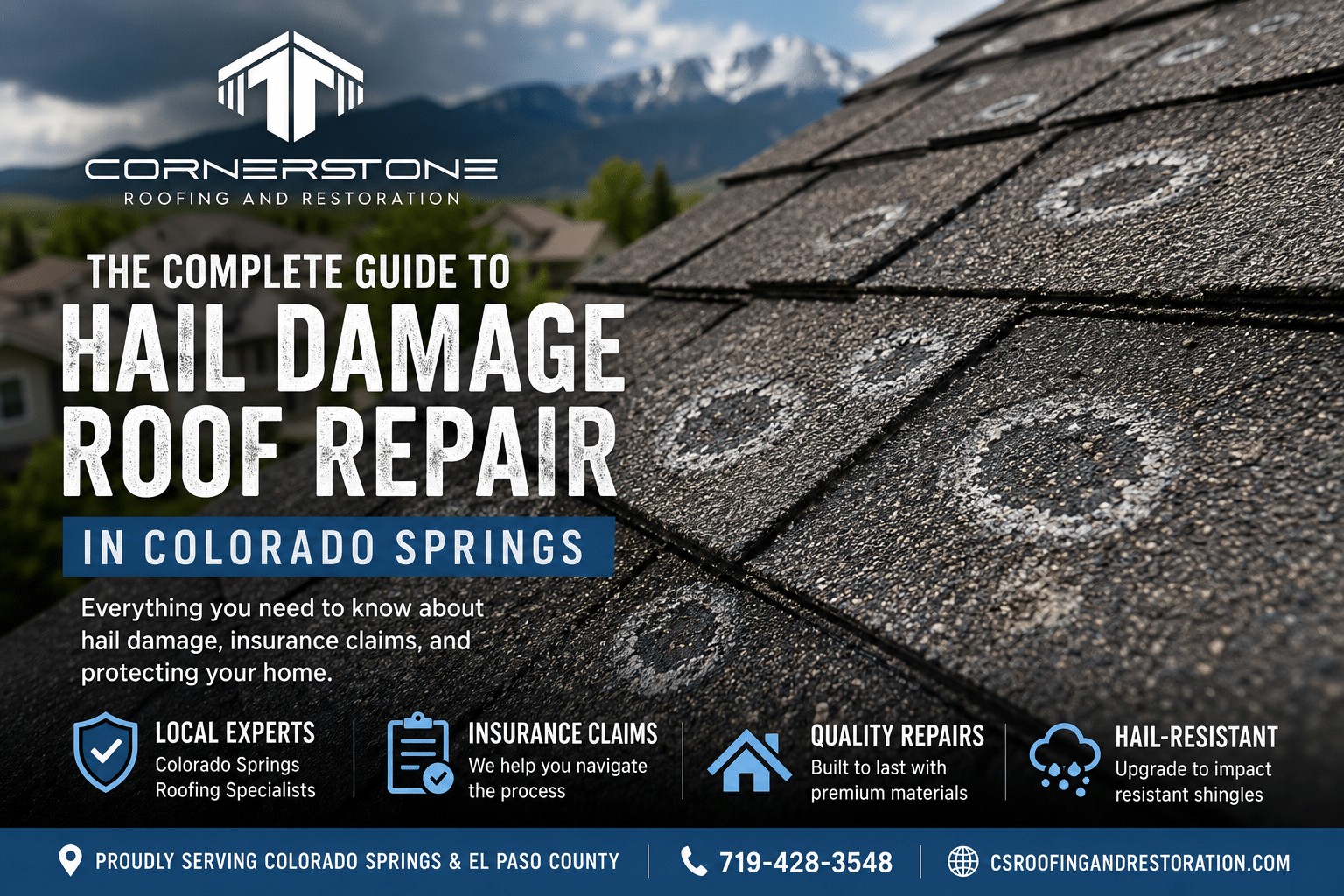

If you live in Colorado Springs, hail isn’t a matter of if — it’s a matter of when. El Paso County sits squarely in the heart of “Hail Alley,” the stretch of Colorado, Wyoming, and Nebraska where some of the most damaging hailstorms in the United States touch down every spring and summer. According to insurance industry data, Colorado consistently ranks among the top five states for hail damage claims, with the Front Range corridor — from Castle Rock through Colorado Springs to Pueblo — taking the brunt of it.
For Colorado Springs homeowners, this means your roof faces a level of punishment most American roofs never experience. A single severe storm can drop quarter-sized to baseball-sized hail across an entire neighborhood in a matter of minutes, leaving thousands of homes with damage that ranges from cosmetic to catastrophic.
The good news? With the right contractor, the right materials, and the right approach to insurance claims, hail damage doesn’t have to be a financial disaster. This complete guide walks you through everything you need to know about hail damage roof repair in Colorado Springs — from spotting the damage to filing your claim to choosing impact-resistant materials that can prevent the same headache next storm season.
Why Colorado Springs Hail Is So Destructive
Colorado Springs sits at over 6,000 feet of elevation, where atmospheric conditions create the perfect environment for severe hailstorms. Warm, moist air rising from the plains collides with cool, dry mountain air, generating powerful supercell thunderstorms with the strong updrafts needed to suspend hailstones long enough for them to grow large.
The result: hailstones in Colorado Springs routinely reach golf-ball size (1.75 inches) and not uncommonly grow to baseball size (2.75 inches) or larger. At those sizes, hail falls at terminal velocities of 70-100 mph, hitting your roof with enough energy to crack shingles, dent metal flashing, and shatter skylights.
Asphalt shingles — the most common roofing material on Colorado Springs homes — are particularly vulnerable. When a hailstone strikes, it can:
- Fracture the asphalt matting beneath the protective granule layer (an injury called “bruising” that’s hard to see from the ground)
- Dislodge granules, exposing the asphalt to UV radiation and accelerating shingle deterioration
- Crack the fiberglass mat that gives shingles their structural integrity
- Knock loose the seal strip that bonds shingles together against wind
Even when your roof looks fine from the curb, the damage hidden up there can drastically shorten its lifespan and create leak risk over the next 6-24 months.
Signs of Hail Damage You Can Spot from the Ground
You should never climb on your roof after a storm — that’s a job for a trained professional with safety equipment. But you can look for these warning signs from the ground:
Damage to gutters and downspouts. Aluminum gutters dent easily. If you see fresh dimples or dents along your gutters or downspouts, your roof almost certainly took similar impacts.
Damage to soft metal flashings and vents. Check the metal caps on roof vents, the flashing around chimneys, and any exposed pipe boots. Dents, cracks, or split seams indicate severe hail impacts.
Damage to siding, fences, garage doors, and outdoor furniture. If hail dented your patio chairs or cracked your vinyl siding, it hit your roof harder than that.
Shingle granules in your gutters or at the base of downspouts. A handful of granules is normal weathering. Piles of granules — especially right after a storm — is a sign your shingles lost protective material during the hail event.
Bald spots or color variation in your shingles. Look at your roof from across the street. If you see patches of darker color (where granules are missing), that’s hail bruising.
Window screens with tiny tears or holes. Hail strong enough to puncture screens is strong enough to damage shingles.
If you spot any of these signs, schedule a free professional roof inspection before contacting your insurance company. A roofing contractor can document the damage properly, which makes your insurance claim far more likely to succeed.
What to Do Immediately After a Hailstorm
The first 30 days after a hailstorm are critical. Here’s the right sequence of actions:
Step 1: Document from the ground. Take photos and video of any visible damage to your property — gutters, siding, screens, outdoor furniture, vehicles. Note the date, time, and approximate hail size if you can. These records will support your insurance claim later.
Step 2: Don’t sign anything yet. In the hours after a major storm, roofers (including out-of-state storm chasers) will canvas neighborhoods knocking on doors, offering “free inspections” with high-pressure contracts attached. Politely decline anything that requires a signature on the spot.
Step 3: Call a local, licensed Colorado roofing contractor for a free inspection. A reputable local roofer will provide a thorough on-roof inspection at no cost and document the damage with detailed photos. Use their report to inform your decision about whether to file a claim.
Step 4: Contact your insurance company AFTER the inspection. Most Colorado homeowner insurance policies have a 1-year deadline to file hail damage claims, but waiting too long can complicate matters. Once you have professional documentation in hand, contact your insurance carrier to open a claim.
Step 5: Schedule the adjuster meeting with your contractor present. This is the single most important step in the entire claims process. When the insurance adjuster comes to inspect your roof, your contractor should be there too. The adjuster and contractor walk the roof together, identify damage, and reach agreement on scope of work. This back-and-forth typically results in more complete coverage than if you handle it alone.
The Hail Damage Insurance Claim Process
Filing a roofing insurance claim in Colorado follows a fairly predictable pattern, but knowing the process up front prevents nasty surprises:
The free inspection. Your contractor documents damage with photos, measurements, and a detailed report.
Opening the claim. You call your insurance company and provide them with the loss date, your contractor’s report, and any photos you took.
The adjuster visit. Your insurance company sends out an adjuster (sometimes an independent third party) to inspect the damage. This is when your contractor should be present.
The scope of loss. After the inspection, your adjuster prepares a “scope of loss” document — essentially an itemized list of what the insurance company agrees to pay for. Your contractor reviews this for accuracy. Common errors at this stage include missing line items for code-required upgrades, omitting underlayment or flashing replacement, and using outdated unit pricing.
Supplements. If the adjuster missed items that should be covered, your contractor files a “supplement” — additional documentation requesting coverage for the missed work. Supplements are normal in roofing claims; most claims involve at least one.
The first check. Once the claim is approved, your insurance company issues an ACV (Actual Cash Value) check — the depreciated value of your roof. You pay your deductible, and the contractor begins work.
Final completion and depreciation release. Once the work is complete, your contractor sends final invoices and certifications to your insurance company, which then releases the depreciation portion (the difference between ACV and Replacement Cost Value). This second check covers the remainder of the project cost.
The entire process typically takes 30-90 days from initial damage to final completion, though severe storms with high claim volume can stretch this timeline.
How to Choose the Right Roofing Company After Hail Damage
Not every roofer who shows up at your door after a hailstorm is qualified to handle the work or the claim. Here’s how to separate the professionals from the storm chasers:
They have a physical local presence. Look for a Colorado address, not a P.O. box. Verify the company has been operating in the area for at least a few years and check their reviews on Google Business Profile.
They’re licensed and insured in Colorado. Ask for proof of their Colorado contractor license, general liability insurance, and workers’ compensation coverage. A legitimate roofer will provide this without hesitation.
They’re certified by major manufacturers. Certifications from IKO, Atlas Roofing, GAF, or Owens Corning indicate factory training and quality standards. Manufacturer-certified contractors can offer extended warranties that standard contractors cannot.
They don’t pressure you to sign immediately. A reputable contractor gives you time to make an informed decision. Storm chasers want signatures before homeowners can shop around.
They never offer to “waive” or “absorb” your insurance deductible. This is a federal offense and a violation of Colorado law. Any contractor who suggests it is asking you to commit insurance fraud.
They specialize in insurance claims and have direct experience working with adjusters. Ask how many hail claims they’ve handled in the last year. The answer should be in the dozens or hundreds, not single digits.
They provide written warranties on both workmanship and materials. Standard manufacturer warranties cover materials; a separate workmanship warranty covers the installation itself.
Impact-Resistant Shingles: Your Best Defense Against the Next Storm
When you’re replacing a hail-damaged roof, you have an opportunity to install materials that can dramatically reduce damage in the next storm. Class 4 impact-resistant shingles are tested to withstand a 2-inch steel ball dropped from 20 feet — roughly equivalent to baseball-sized hail.
The two main shingle classes Colorado Springs homeowners should consider are:
Class 3 impact-resistant shingles. Tested with a 1.75-inch steel ball. Provide significantly better hail resistance than standard architectural shingles. Examples include certain IKO Cambridge and Atlas Pinnacle lines.
Class 4 impact-resistant shingles. The highest impact rating available. Examples include IKO Dynasty (with ArmourZone technology), Atlas StormMaster Shake, and Malarkey Vista AR.
Beyond preventing damage, Class 4 shingles often qualify Colorado homeowners for substantial discounts on their homeowner insurance — typically 10-30% off the wind/hail portion of their premium. Over the lifetime of the roof, these discounts can add up to thousands of dollars in savings, often paying for the upgrade entirely.
Worth noting: not all hail-resistant shingles are created equal. The UL 2218 standard tests impact resistance, and you should specifically ask your contractor about UL 2218 Class 4 rating before agreeing to “impact-resistant” shingles. The Insurance Institute for Business & Home Safety also maintains a public database of tested products if you want to verify a specific shingle’s rating.
When Repair Is Enough vs. When You Need Full Replacement
Not every hail-damaged roof needs full replacement. A skilled contractor will help you weigh several factors:
Severity of damage. Insurance companies generally have a “test square” rule — typically 8 or more hits in a 10-foot by 10-foot square indicates the roof needs replacement rather than spot repairs.
Age of the roof. Roofs nearing the end of their lifespan are usually better replaced than repaired, since the underlying shingles will deteriorate faster than new ones.
Insurance coverage. If your policy is ACV (Actual Cash Value), depreciation may make a partial repair more economical. If you have RCV (Replacement Cost Value) coverage, full replacement is typically covered when warranted.
Manufacturer warranty implications. Patching small areas of a hail-damaged roof may void the original manufacturer warranty, leaving you exposed if the rest of the roof fails.
Code-required upgrades. Newer Colorado Springs building codes may require upgrades (like enhanced underlayment, ice and water shield, or ventilation) when more than a certain percentage of the roof is being replaced. Insurance is generally required to cover these code upgrades.
A reputable contractor will give you an honest assessment of whether your situation warrants repair or replacement. Beware of any contractor whose first recommendation is always “full tear-off” regardless of the damage extent.
Frequently Asked Questions
How quickly should I file a hail damage insurance claim?
File as soon as possible after you have professional documentation. Most Colorado homeowner policies allow up to 1 year from the date of loss, but acting within the first 30-60 days gives you the best chance of clean approval. Delays make it harder to prove the damage came from the specific storm event.
Will my insurance premium go up after filing a hail claim?
Generally, no. Hail damage is considered an “act of nature” claim, which most insurance carriers do not penalize through premium increases the way they do for liability or theft claims. However, multiple claims over a short period can affect your renewal. Discuss specifics with your agent before filing if you have concerns.
What if my insurance company denies my hail damage claim?
You have options. First, request a written explanation of the denial. Then have your contractor file a formal supplement with additional documentation. If the denial stands, you can request a re-inspection with a different adjuster, file a complaint with the Colorado Division of Insurance, or hire a public adjuster to advocate on your behalf.
How long does hail damage roof repair take?
For most Colorado Springs homes, a full roof replacement after hail damage takes 1-3 days of actual installation, plus a week or two for material ordering, scheduling, and final inspections. Larger or more complex roofs (steep slopes, multiple stories, intricate geometry) may take longer.
Can I claim hail damage on a roof that’s older than 10 or 15 years?
Yes. The age of your roof doesn’t disqualify you from filing a claim. However, insurance coverage may be limited to ACV (depreciated value) rather than full replacement cost on older roofs. Your contractor and insurance adjuster will determine what’s covered.
Get Your Free Colorado Springs Hail Damage Inspection
If you’ve experienced a recent hailstorm — or even if you’re not sure whether last spring’s storm caused damage — schedule a free, no-obligation roof inspection with Cornerstone Roofing & Restoration. Our licensed, insured Colorado Springs roofing contractors will document any damage, walk you through the insurance claim process, and help you make an informed decision about your next steps.
Cornerstone Roofing & Restoration is IKO-certified, locally owned, and has guided hundreds of El Paso County homeowners through successful insurance claims for hail damage. We work directly with your adjuster, advocate for full coverage, and install premium materials backed by manufacturer warranties of up to 50 years.
Call (719) 600-7852 today or schedule your free inspection online.
We proudly serve Colorado Springs, Monument, Castle Rock, Aurora, Black Forest, Peyton, Manitou Springs, Gleneagle, Larkspur, Stratmoor, and all surrounding Front Range communities.